
Have you ever wondered how sound travels through different mediums? Understanding the difference between acoustic waves and mechanical waves is crucial in realms from audio engineering to medical imaging. Acoustic waves are vibrations that travel through air or water, while mechanical waves require a solid medium to propagate. This distinction not only underlines fundamental principles of physics but also impacts everyday technologies, such as musical instruments and ultrasound devices. By grasping these concepts, you can enhance your comprehension of various applications, whether you’re a curious learner, a student, or a professional seeking deeper technical insights. Dive into the fascinating world of wave mechanics and discover how these fundamental concepts shape our experience of sound and beyond.
What Are Acoustic Waves?

Acoustic waves are a fascinating subset of mechanical waves that play an essential role in our daily lives, from the sounds we hear to the technologies we use. These waves propagate through various media, including air, water, and solids, by causing particles in the medium to vibrate back and forth around their equilibrium positions. This motion creates areas of compression and rarefaction, which travel through the medium carrying energy. A common example of acoustic waves in action is the sound of a musical instrument, where the vibrations generate audible sound waves that can be perceived by our ears.
One key aspect of acoustic waves is that they are longitudinal waves-meaning that the particle displacement is parallel to the direction of wave propagation. This allows for efficient energy transfer, especially in gases where the spacing between particles is relatively wide compared to solids. The characteristics of acoustic waves, such as frequency, wavelength, and amplitude, define the qualities of the sound we hear. For instance, higher frequency waves correspond to higher pitch sounds, whereas greater amplitude results in louder sounds.
Acoustic waves have a wide range of applications in technology, including medical imaging (such as ultrasounds), sonar used in underwater exploration, and even in various industrial processes for non-destructive testing. Understanding acoustic waves not only enhances our appreciation of sound and its properties but also opens up opportunities for innovations in multiple fields. As research continues to develop, the exploration of acoustic wave applications could lead to breakthroughs in communication, material science, and environmental monitoring, showcasing the profound impact these waves have on our world.
Understanding Mechanical Waves
Mechanical waves are a fundamental concept in physics, representing disturbances that propagate through a medium due to the perturbation of particles. These waves can be observed in everyday occurrences, such as the ripples on the surface of a pond or the vibrations of a guitar string. Essentially, mechanical waves require a material medium-be it solid, liquid, or gas-to transmit energy, unlike electromagnetic waves, which can travel through a vacuum.
There are two primary classifications of mechanical waves: longitudinal and transverse. In longitudinal waves, such as sound waves, particles of the medium move parallel to the direction of wave propagation. This effect creates regions of compression and rarefaction, enabling efficient energy transport through gases, where particle spacing allows for swift interactions. On the other hand, transverse waves, like those found in strings or water surfaces, have particle movement perpendicular to the wave direction. Understanding these distinctions is crucial for comprehending not only the scientific principles behind mechanical waves but also their practical applications.
Mechanical waves play a significant role in technology and various industries. For example, seismic waves generated by earthquakes (a form of mechanical wave) are crucial for understanding the earth’s interior and predicting seismic events. Similarly, the principles of mechanical waves are utilized in non-destructive testing methods, where sound waves evaluate material integrity without causing damage. These applications highlight the importance of mechanical waves in both scientific research and technological advancement, underscoring their ubiquitous presence in our lives.
In summary, mechanical waves are much more than just a theoretical concept; they have tangible implications in real-world applications and an array of phenomena. Whether through the study of acoustics in music, the development of ultrasound imaging in medicine, or the examination of materials through wave propagation, a profound understanding of mechanical waves opens the door to numerous fields of exploration and innovation.
Key Differences Between Acoustic and Mechanical Waves
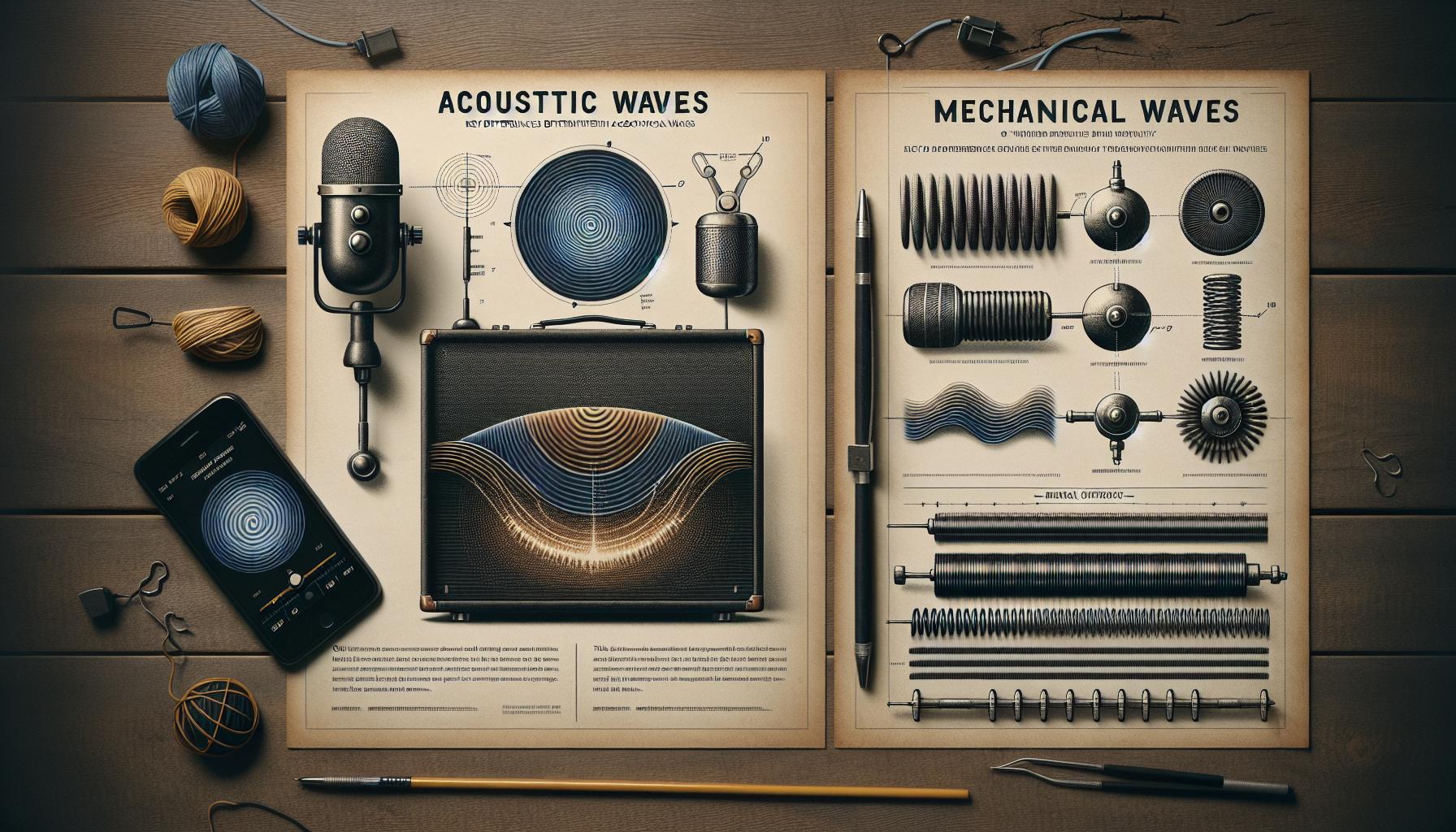
Understanding the distinctions between acoustic waves and mechanical waves is essential for grasping various scientific and engineering concepts. While both types of waves involve the transfer of energy through a medium, they differ significantly in their behaviors and characteristics. Acoustic waves, specifically, are a subset of mechanical waves that propagate sound through different mediums-typically gases, liquids, and solids. They play a crucial role in fields such as audio engineering, medicine (ultrasound), and telecommunications.
One fundamental difference to highlight is the nature of their propagation. Acoustic waves are longitudinal waves, meaning that the oscillations of particles in the medium occur parallel to the direction of the wave’s travel. This results in areas of compression and rarefaction, which are critical in generating sound. In contrast, mechanical waves can also be transverse, where particle movement is perpendicular to wave direction, as seen in water waves or waves on a string. Acoustic waves specifically deal with the vibrational energy transferred through these compressions and rarefactions, making them uniquely suited to carry sound information.
Additionally, the terminology used to describe acoustic phenomena often reflects their specialized nature. For example, sound intensity refers to the power per unit area carried by the acoustic wave, while frequency (the number of wave cycles that pass a point per second) directly influences the tone or pitch of the sound produced. In comparison, mechanical waves might be studied in broader contexts, such as seismic waves-which can include both longitudinal and transverse waves-allowing for applications in geology and construction.
In practical applications, the focus of acoustic waves on sound allows for sophisticated technologies, like sonar and ultrasonic cleaning, to be developed. Each application leverages the predictable behavior of acoustic waves to deliver specific results, demonstrating their unique impact within the wider domain of mechanical waves. Recognizing these differences empowers engineers, scientists, and learners alike to harness the power of wave mechanics effectively, whether in designing musical instruments, developing medical imaging systems, or improving communication technologies.
Applications of Acoustic Waves in Technology

Acoustic waves serve as the backbone for many modern technologies, transcending mere sound transmission and enabling a wide range of practical applications. From the subtleties of music reproduction to advanced medical imaging techniques, understanding how acoustic waves work can illuminate their far-reaching impact on various industries. For instance, the principle of sonar, which relies on acoustic wave propagation through water, allows submarines to map their underwater surroundings, detect other vessels, and even locate fish schools. This technology exemplifies how acoustic waves not only convey information but also interact dynamically with their environments.
Medical Applications
One of the most significant applications of acoustic waves is found in the medical field, particularly through techniques like ultrasound. Ultrasound imaging utilizes high-frequency sound waves to create detailed images of the inside of the body, allowing physicians to monitor fetal development, diagnose conditions, or guide procedures. Because acoustic waves can penetrate different tissues and their echoes vary according to tissue density, this method provides a non-invasive insight into internal structures. Furthermore, therapeutic ultrasound uses focused acoustic energy for treatments, enhancing blood flow and tissue repair.
Industrial Uses
In industrial settings, acoustic waves are leveraged for non-destructive testing (NDT) methods, ensuring the integrity and safety of materials and structures. Techniques such as ultrasonic testing enable engineers to detect internal flaws in metals and welds without compromising their functionality. This application is critical in sectors like aerospace, construction, and manufacturing, where even minor defects can lead to catastrophic failures. Additionally, ultrasonic cleaning employs high-frequency acoustic waves to agitate a fluid, effectively removing dirt and impurities from hard-to-reach areas, making it invaluable in both industrial and everyday contexts.
Consumer Technology
On the consumer technology front, the rise of smart devices has incorporated acoustic wave technology in various forms. Voice recognition systems, used in smartphones and smart speakers, rely on the ability of acoustic waves to be converted into digital signals, allowing for hands-free operation and interaction. Moreover, advancements in audio technology, such as high-fidelity speakers and noise-canceling headphones, capitalize on precise manipulation of sound waves to enhance listening experiences. These innovations not only improve user experiences but also illustrate the importance of acoustic waves in digital communication.
In summary, the diverse applications of acoustic waves extend their relevance far beyond simple sound transmission, penetrating fields as varied as healthcare, industry, and consumer technology. As research continues and technology evolves, the potential for acoustic waves to solve complex challenges only grows, promising exciting advancements in the years to come.
Applications of Mechanical Waves in Real Life
Mechanical waves are integral to our daily lives, influencing various forms of communication, energy transfer, and even the environments we inhabit. Unlike acoustic waves, which are a specific type of mechanical wave primarily associated with sound, mechanical waves encompass a broader range of phenomena, including seismic waves and waves in fluids. Understanding their applications opens up a world of insights into how we can utilize these basic yet powerful concepts in real-world scenarios.
One of the most fascinating applications of mechanical waves is found in the field of seismology. When earthquakes occur, seismic waves propagate through the Earth, carrying energy away from the epicenter. Seismographs detect these waves, allowing scientists to study the Earth’s inner structure and improve our understanding of tectonic activities. This capability is vital not only for predicting potential hazards but also for designing earthquake-resistant buildings and infrastructure that can withstand tremors.
In the realm of communication technology, mechanical waves play a crucial role in the functioning of devices such as fiber optic cables. Although light is the primary mode of information transfer in these systems, mechanical stresses and vibrations in the cables can affect signal integrity. Engineers use this knowledge to design cables that minimize signal loss and enhance performance, showcasing the interplay between mechanical wave dynamics and modern technology.
Moreover, mechanical waves are essential in medical applications. Techniques like Magnetic Resonance Imaging (MRI) utilize radio waves-another form of mechanical wave-to create detailed images of organs and tissues. By manipulating the behavior of these waves in different materials, healthcare professionals can gain crucial insights into patient conditions without resorting to invasive procedures. This innovative use of mechanical waves underscores their versatility across various fields.
Finally, mechanical waves also enhance our everyday experiences through technologies such as ultrasonic cleaning. This process employs high-frequency mechanical waves in a liquid to agitate and remove dirt from items like jewelry and lenses. The effectiveness of such cleaning methods demonstrates how manipulating mechanical waves can lead to practical, efficient solutions in our daily routines.
In summary, from providing critical data about the Earth to enhancing our communication systems and medical imaging, mechanical waves play an indispensable role in a variety of applications, bridging theory and practical use in ways that profoundly affect our lives.
How Acoustic Waves Travel Through Different Mediums
Acoustic waves, the vibrations that carry sound, are remarkable in how they navigate various environments. These waves are mechanical in nature, meaning they require a medium-such as air, water, or solids-to propagate. The properties of these mediums significantly influence how sound travels, affecting its speed, intensity, and quality.
When acoustic waves move through different materials, they experience changes in velocity due to variations in density and elasticity. For instance, sound travels faster in water (approximately 1,480 meters per second) than in air (around 343 meters per second). This difference occurs because water’s higher density allows sound waves to transmit energy more effectively. In solids, such as metals, the speed of sound can be even greater, exceeding 5,000 meters per second. This speed variation can be crucial in applications ranging from underwater sonar to architectural acoustics, where understanding how sound behaves in a particular setting can enhance design and functionality.
The medium also affects how sound waves are absorbed, reflected, or refracted. In denser materials, sound waves may be partially reflected at the boundary, creating echoes, or they may pass through with altered characteristics. This phenomenon explains why moving from one environment to another-like entering a concert hall from a busy street-can drastically change how sound is perceived. Notably, sound insulation materials are designed to reduce reflection and absorption, ensuring clearer audio transmission in spaces like recording studios or theaters.
Moreover, temperature plays a crucial role in the behavior of acoustic waves. Warmer air, which is less dense than cooler air, allows sound to travel faster. This principle is particularly evident on hot days when sound seems to carry further due to the warm air conditions. Understanding these interactions is vital not only for acoustic engineers and sound designers but also for anyone interested in optimizing sound quality in various settings, from everyday listening environments to professional sound production.
In summary, the journey of acoustic waves through different mediums is complex and influenced by material properties, temperature, and even the wave’s frequency. Recognizing these factors can lead to practical applications in numerous fields, from audio engineering to environmental science, enabling the design of better sound systems and improved understanding of natural phenomena.
The Role of Frequency in Acoustic and Mechanical Waves
The perception of sound, whether it’s the gentle rustle of leaves or the roar of a jet engine, is deeply intertwined with the concept of frequency. Frequency, measured in Hertz (Hz), refers to the number of cycles of a wave that pass a fixed point in one second. In the context of acoustic and mechanical waves, frequency plays a crucial role in determining the characteristics of the waves and how they are experienced by us. For example, sound waves that fall within the range of 20 Hz to 20 kHz are audible to humans; anything below or above this range is considered infrasonic or ultrasonic, respectively.
Different frequencies correspond to different pitches: higher frequencies produce higher pitches, while lower frequencies yield lower pitches. This principle applies equally to musical instruments, wherein a violin string vibrating at 440 Hz generates the note A, while a double bass string vibrating at 110 Hz produces a lower note. The way these frequencies propagate through various media defines not only how we perceive sound but also how sound can be manipulated. For instance, in the medical field, high-frequency ultrasound waves are utilized to create images for diagnostics, such as in fetal monitoring and organ imaging.
Resonance and Frequency
The phenomenon of resonance significantly illustrates the role of frequency in both acoustic and mechanical waves. Resonance occurs when an object vibrates at its natural frequency, which can amplify sound or motion. For example, when a tuning fork is struck, it emits a sound at a specific frequency. If that frequency matches the natural frequency of a nearby glass, the glass can begin to resonate, potentially shattering as energy builds up. This principle is not limited to sound; mechanical systems like bridges or buildings can experience resonance during earthquakes, underscoring the importance of understanding frequency in engineering and safety.
Practical Applications
Real-world applications of frequency span diverse fields, from communications to environmental science. In wireless communications, specific frequencies are allocated for different signals, allowing multiple broadcasts without interference. Similarly, in environmental monitoring, specific acoustic frequencies can be emitted underwater to study marine life or detect changes in ecosystem conditions. Understanding frequency not only helps in optimizing these technologies but also in interpreting the results effectively.
Ultimately, frequency serves as a cornerstone in the mechanics of waves, influencing how sound is generated, perceived, and utilized across various domains. Whether you’re listening to music, diagnosing a medical condition, or studying natural phenomena, the frequency of waves determines much of our auditory and mechanical experiences. By grasping the nuances of frequency, we can maximize our applications of acoustic and mechanical waves, paving the way for advancements in technology and understanding.
Energy Transmission in Acoustic vs. Mechanical Waves
Energy transmission is a fundamental aspect of both acoustic and mechanical waves, influencing how these waves propagate and interact with their environments. Both types of waves rely on the movement of particles within a medium to convey energy, but the mechanisms and efficiency of this transmission can differ significantly.
In acoustic waves, energy is transmitted through the sequential compression and rarefaction of particles in a medium, typically air, water, or solids. When a sound wave travels, it causes particles in the medium to vibrate back and forth around their equilibrium positions, transferring energy from one particle to the next. This process relies on the elasticity of the medium; the more elastic the medium, the more efficiently the energy is transmitted. For example, sound travels faster in water than in air due to the denser arrangement of molecules, which facilitates quicker particle interaction. Acoustic energy is therefore highly dependent on the medium’s properties, including its temperature and density.
Conversely, mechanical waves encompass a broader range of phenomena, including not only sound but also seismic waves, water waves, and waves along strings. The energy transmission in mechanical waves can involve both longitudinal and transverse movements of particles, depending on the wave type. For instance, in transverse waves, such as those found on a string, energy travels perpendicular to the direction of particle displacement. This difference leads to unique applications – for example, in engineering, understanding the behavior of mechanical waves is crucial for designing structures that can withstand the energy transfer during earthquakes.
Another critical factor in energy transmission is wave frequency. Higher frequency waves can transmit energy more rapidly, which is why ultrasound is effective in medical imaging – the waves can produce detailed images because their high frequency results in more frequent energy transfers at smaller scales. However, energy transmission also diminishes with increasing frequency due to factors like absorption and scattering, making lower frequency waves more effective over longer distances in some applications.
Ultimately, recognizing the differences in energy transmission mechanisms helps inform practical applications, from sound engineering to earthquake resilience and beyond. Understanding how these waves operate allows us to leverage their unique properties to enhance technologies across various fields.
Common Misconceptions About Acoustic and Mechanical Waves
Many people believe acoustic waves and mechanical waves are synonymous, but this is a common misconception. While acoustic waves are indeed a type of mechanical wave, not all mechanical waves are acoustic in nature. The distinction lies in the specific characteristics and mediums through which these waves travel. Acoustic waves travel through air, water, or solids and are primarily associated with sound, characterized by pressure variations in the medium. On the other hand, mechanical waves encompass a broader category that includes any wave requiring a medium to propagate, such as seismic waves, water waves, and waves on strings.
Another misconception revolves around the concept of speed and energy transmission. Many assume that because acoustic waves are sound waves, they inherently travel faster than all other types of mechanical waves. This is not entirely accurate. The speed of wave propagation depends significantly on the medium through which they move. For instance, sound waves travel much faster in water than in air due to the closer proximity of water molecules, enabling quicker energy transfer. Conversely, seismic waves can travel at even greater speeds in solids, illustrating that mechanical properties of the medium play the primary role in determining wave speed.
The role of frequency also adds to the confusion. There’s a common belief that higher frequency always equates to higher energy. While it’s true that higher frequency waves, such as ultrasound, can transmit more information in a shorter time, the overall energy transmitted depends on multiple factors including amplitude and medium characteristics. Thus, a low-frequency wave can carry significant energy over long distances, especially in applications like radio transmissions, where lower frequencies can penetrate through various barriers more effectively than high frequencies.
In summary, understanding the nuanced differences between acoustic and mechanical waves is essential for grasping wave behavior in different contexts. Whether it’s for academic pursuits or practical applications such as engineering and medical imaging, a clear comprehension of these concepts allows for better utilization of wave technologies in their respective fields. By demystifying these misconceptions, we can enhance our understanding of wave dynamics and their importance in our daily lives.
Impact of Temperature and Medium on Wave Behavior
As we delve into the intricacies of wave phenomena, it’s fascinating to consider how both temperature and the medium through which waves travel profoundly influence their behavior. The relationship between wave properties and environmental conditions is not just academic; it has significant implications in various fields, from telecommunications to environmental science.
Acoustic waves, classified as mechanical waves, depend on the medium’s characteristics-such as density, elasticity, and temperature-for their propagation. In air, for instance, sound waves travel faster in warmer conditions. This increase in temperature reduces the density of air, allowing sound waves to move more swiftly as the molecules are more energetic and collide more frequently. To illustrate, at 20°C (68°F), sound travels at approximately 343 meters per second, while at 0°C (32°F), it slows to about 331 meters per second. This temperature dependency is pivotal for applications like weather forecasting and acoustic engineering, where precise measurements of sound transmission are necessary.
In liquid and solid media, temperature still plays a crucial role, but the effects can be even more pronounced. For example, sound travels faster in water-about four times faster than in air-due to the closer arrangement of water molecules. However, as temperatures rise, the speed can increase significantly because the molecules in warmer water vibrate faster, enabling quicker energy transfer. This principle is vital for underwater acoustic technologies, like sonar, where temperature gradients in the ocean can impact sound wave behavior and detection accuracy.
Medium Composition and Wave Behavior
The composition of the medium also dramatically affects how waves propagate. In solids, for example, the type of material-be it wood, metal, or rubber-determines not only the speed of sound but also the way it attenuates or reflects. Metals, being dense and elastic, allow sound to travel efficiently and at higher speeds than in materials like rubber. This variance is vital for engineers designing structures that must control sound transmission-like concert halls or soundproof rooms.
- Density: Higher density typically leads to slower sound speeds in gases, while the opposite is true in solids due to their molecular structure.
- Elasticity: More elastic materials facilitate faster sound propagation, as they return to their original shape quickly, allowing for quick molecule interactions.
- Phase of the Medium: The state of matter (solid, liquid, gas) changes wave characteristics, with solids typically allowing faster and more efficient wave transmission.
Understanding these factors equips researchers and practitioners with the knowledge to manipulate wave behavior for practical applications, ensuring optimal performance in diverse environments-from designing better acoustic instruments to improving telecommunications technologies. By appreciating how temperature and medium interact, we can harness these principles to innovate and solve real-world problems effectively.
Visualizing Waves: Diagrams and Equations Explained
To truly grasp the nuances of acoustic and mechanical waves, visual aids such as diagrams and equations can be invaluable. These tools not only clarify concepts but also serve as a bridge between theory and practical application. One of the foundational diagrams in wave physics is the sine wave, which represents simple harmonic motion. This visual illustrates how waves oscillate around an equilibrium position. For acoustic waves, this oscillation corresponds to variations in pressure in the medium-whether it be air, water, or solids-depicting how sound propagates through these environments.
When considering wave behavior, it’s important to integrate key equations that inform our understanding. The wave equation, expressed as ( v = f lambda ), is pivotal. Here, ( v ) denotes the wave speed, ( f ) represents frequency, and ( lambda ) symbolizes wavelength. This relationship highlights how changes in frequency affect wavelength and wave speed, crucial not just for theoretical understanding but for practical applications like tuning musical instruments or in acoustic engineering where precise adjustments to sound properties are necessary.
Visualizing Wave Properties
Diagrams can be utilized to illustrate various properties of waves, including amplitude, frequency, and wavelength. Amplitude represents the maximum displacement from the equilibrium position, influencing the loudness of sound. In contrast, frequency determines the pitch; higher frequencies correspond to higher pitches. Understanding these concepts is critical for engineers who design audio equipment, as it allows them to manipulate these parameters effectively.
- Amplitude (A): The height of the wave from its rest position, directly correlating with the loudness of the sound.
- Frequency (f): The number of cycles per second measured in hertz (Hz); higher frequencies result in higher pitches.
- Wavelength (λ): The distance between successive crests (or troughs), which inversely relates to frequency; shorter wavelengths mean higher frequencies.
Incorporating tables can also enhance understanding. For example, a table could compare sound speeds in different media, illustrating how they change according to physical properties:
| Medium | Speed of Sound (m/s) |
|---|---|
| Air (20°C) | 343 |
| Water | 1482 |
| Steel | 5960 |
These visual representations not only cater to varied learning styles but also enhance retention of complex concepts. By demystifying the behavior of acoustic and mechanical waves through diagrams and equations, we empower students, researchers, and practitioners to apply this knowledge effectively in fields ranging from acoustics to engineering, paving the way for innovations in sound technology. Understanding these foundational aspects ultimately leads to richer explorations of wave phenomena and their applications in various domains.
Future Trends in Wave Technology and Research
The interplay between acoustic and mechanical waves is evolving rapidly, prompting exciting developments across various fields. As researchers continue to innovate, the future of wave technology promises to lead us into uncharted territories of application and exploration. One of the most significant trends involves leveraging advanced algorithms and AI to optimize wave propagation and manipulation. This capability is already paving the way for enhanced imaging systems, such as ultrasound technologies that provide high-resolution images in medical diagnostics, allowing for earlier detection and treatment of conditions.
In telecommunications, the precision of acoustic waves is being harnessed to improve data transmission. Optical and acoustic technologies are converging, using sound waves to transmit data faster and more efficiently over long distances. Innovations such as photonic acoustic wave devices can facilitate terahertz communication, which offers vast bandwidth for next-generation wireless networks. As 5G networks expand, the demand for high-speed, low-latency communication will further drive breakthroughs in this area.
Another area ripe for growth is the exploration of acoustic metamaterials-engineered materials that manipulate sound waves in unconventional ways. These materials have astounding potential to create new soundproofing solutions or “invisibility cloaks” for sound, which could drastically change architectural design and personal audio experiences. As researchers delve deeper into the mechanics of these materials, we can expect to see the emergence of innovative tools that redefine sound control and sound-based technologies.
Moreover, understanding how acoustic waves interact with living organisms is opening doors in the field of biomedicine. For instance, researchers are investigating the therapeutic applications of ultrasound, not just for imaging but also for targeted drug delivery and even tissue regeneration. The intersection of physics, biology, and engineering is fostering a multidisciplinary approach that promises to revolutionize patient care and treatments.
The future is bright, filled with potential applications that link theoretical insights into wave behavior with practical advancements in technology and health. As we continue to decode the mysteries of acoustic and mechanical waves, the possibilities for improving our lives and pushing the boundaries of technology seem virtually limitless.
FAQ
Q: What are the main characteristics of acoustic waves?
A: Acoustic waves are mechanical waves that transmit sound through various media. Key characteristics include the ability to travel through solids, liquids, and gases, reliance on particle vibration for propagation, and frequency ranges that affect pitch and timbre. For more on wave properties, check our section on How Acoustic Waves Travel Through Different Mediums.
Q: How do acoustic waves differ from other types of mechanical waves?
A: While all acoustic waves are mechanical, not all mechanical waves are acoustic. Acoustic waves carry sound and require a medium, whereas mechanical waves, like seismic waves, may include both sound and other types of energy transfer. This distinction is highlighted in our Key Differences Between Acoustic and Mechanical Waves section.
Q: Can acoustic waves be measured in the same way as mechanical waves?
A: Yes, acoustic waves can be measured using similar principles as mechanical waves, typically involving parameters such as wavelength, frequency, and amplitude. However, specific instruments for sound may include microphones and oscilloscopes. For detailed measurement techniques, refer to our article section on Visualizing Waves: Diagrams and Equations Explained.
Q: What role does temperature play in acoustic and mechanical wave behavior?
A: Temperature affects the speed of both acoustic and mechanical waves, as warmer conditions usually allow waves to travel faster due to reduced density in gases. Explore more about this in our section on Impact of Temperature and Medium on Wave Behavior.
Q: Why are acoustic waves important in technology?
A: Acoustic waves are crucial in various technologies such as medical imaging (ultrasound), sonar for underwater exploration, and audio technology. Their ability to interact with different materials makes them versatile in many practical applications. Visit Applications of Acoustic Waves in Technology for more examples.
Q: What are common applications of mechanical waves in everyday life?
A: Mechanical waves are utilized in several everyday contexts, including seismic waves for earthquake detection, sound waves in communication, and waves on water surfaces for navigation. Learn more in our section on Applications of Mechanical Waves in Real Life.
Q: How does frequency impact the behavior of acoustic versus mechanical waves?
A: Frequency influences not only the pitch of acoustic waves but also the type of mechanical wave produced. Different frequencies can lead to variations in speed and amplitude, affecting sound quality and clarity. For an in-depth look, see The Role of Frequency in Acoustic and Mechanical Waves.
Q: Can mechanical waves exist in a vacuum?
A: No, mechanical waves require a medium (solid, liquid, or gas) to propagate, which means they cannot exist in a vacuum. This contrasts with electromagnetic waves, which can travel through a vacuum. For more comparisons, check our Key Differences Between Acoustic and Mechanical Waves section.
Insights and Conclusions
Thank you for exploring the fascinating differences between acoustic waves and mechanical waves. Understanding these concepts is crucial for many applications, from engineering to environmental science. If you’re eager to dive deeper, check out our articles on Sound Wave Behaviour and Mechanical Energy Transfer that further illustrate these principles in action.
Don’t miss out-subscribe to our newsletter for expert insights and updates directly to your inbox. Have questions or experiences to share? We invite you to join the conversation in the comments below or share this video with your network. Keep learning and stay engaged; the world of waves is vast and ever-evolving!
Get our latest guides, news, and insights highlighted in your Google Search & AI Overviews.