Understanding heat transfer rates is crucial for anyone involved in engineering, HVAC systems, or even cooking. Did you know that effective temperature regulation can significantly impact energy efficiency and comfort levels in buildings? In this guide, we’ll walk you through a step-by-step calculation of heat transfer rate, empowering you to apply these principles in real-world scenarios. By mastering this concept, you can optimize processes, reduce energy consumption, and enhance system performance. Whether you’re a student, researcher, or a professional in the field, grasping how to accurately calculate heat transfer rates opens the door to innovative solutions. Let’s delve into the essentials and equip you with the knowledge to make informed decisions in your projects.
How Heat Transfer Rate Impacts Efficiency
Effective management of heat transfer rates is crucial for optimizing efficiency across various applications, from industrial processes to everyday household items. Understanding how heat transfer rates influence efficiency can lead to significant energy savings, improved product performance, and reduced environmental impact. For instance, in thermal systems like furnaces or heat exchangers, a higher rate of heat transfer often translates to faster heating or cooling times, contributing to operational efficiency.
To grasp the impact of heat transfer rate on efficiency, consider the three primary modes of heat transfer: conduction, convection, and radiation. Each mode operates under different principles and conditions, which can greatly affect the overall system’s efficiency. For example, in conduction, materials with high thermal conductivity (like metals) can transfer heat more effectively than insulators (like wood or plastic). This principle is essential in designing effective thermal interfaces or insulation materials, ensuring that heat loss is minimized during energy transfer processes.
Moreover, several factors play a pivotal role in influencing the heat transfer rate, including surface area, temperature difference, and the nature of the fluid or material involved. In forced convection scenarios, enhancing fluid flow can drastically increase heat transfer rates, thereby improving system efficiency. This principle is often applied in cooling systems, such as those found in automotive and electronic applications, where efficient heat dissipation is vital for performance and longevity. By actively managing these parameters, engineers and designers can create more efficient systems that not only perform better but also consume less energy, aligning with global sustainability goals.
Incorporating the right techniques and technologies can mitigate common pitfalls associated with heat transfer calculations. This includes ensuring accurate measurement of thermal properties and adopting best practices in system design. For instance, utilizing advanced materials such as aerogels for thermal insulation can dramatically reduce unwanted heat transfer, reinforcing efficiency without sacrificing performance. Understanding and mastering these elements is essential for anyone involved in thermal management and system design, providing a pathway to enhanced efficiency and sustainability in various applications.
Understanding the Basics of Heat Transfer Rate

Determining the heat transfer rate is pivotal in various applications-from enhancing the efficiency of industrial systems to improving comfort in residential spaces. The heat transfer rate, often represented as ( Q ), quantifies how much thermal energy moves through a material or system over time. Understanding this concept is crucial not just for engineers but for anyone involved in design, material selection, or environmental control systems.
To grasp the basics, one key aspect is recognizing that heat transfer is fundamentally driven by temperature differences within a system. When there’s a disparity in temperature, energy will naturally move from the hotter area to the cooler area until equilibrium is reached. This principle is the backbone of heat transfer, influencing everything from HVAC systems to thermal insulators. In practical terms, when designing systems, engineers must consider how effectively and rapidly heat can be transferred to ensure optimal performance; think about the quick heat-up times desired in cooktops or the effective cooling in electronics.
When considering heat transfer rate, it’s also important to distinguish between the primary modes of heat transfer: conduction, convection, and radiation. Each mode operates under distinct principles. For instance, conduction occurs in solids where heat moves through direct contact, while convection involves fluid movement-think of how a warm breeze is felt in a room. Radiation, on the other hand, involves energy transfer through electromagnetic waves, such as the warmth from the sun. Recognizing these differences aids in selecting the appropriate materials and methods for efficient heat management.
As you delve deeper into heat transfer calculations, keep in mind several influential factors: the surface area through which heat is exchanged, the temperature gradient between the heat sources, and the properties of the materials involved. These elements will guide you in optimizing designs, whether it’s for a robust industrial process or a simple household appliance. Taking the time to understand these fundamentals equips you with the insight needed for effective thermal management and energy efficiency.
The Essential Formula for Heat Transfer Rate

Determining the heat transfer rate is essential for optimizing energy efficiency in various systems, ranging from industrial processes to household appliances. The basic formula for calculating heat transfer rate, commonly denoted as ( Q ), is derived from Fourier’s Law of Heat Conduction when discussing conduction, but it can be adapted for convection and radiation as well. Understanding this fundamental equation allows engineers and designers to predict how much thermal energy is transferred over time within a given system.
For conduction, the heat transfer rate can be expressed with the formula:
[
Q = k cdot A cdot frac{(T_1 – T_2)}{d}
]
Where:
– ( Q ) = heat transfer rate (W)
– ( k ) = thermal conductivity of the material (W/m·K)
– ( A ) = surface area through which heat is being transferred (m²)
– ( T_1 ) and ( T_2 ) = temperatures of the two sides (°C or K)
– ( d ) = thickness of the material (m)
This formula highlights several key factors that impact the rate of heat transfer. The ( k ) value signifies how effectively a material conducts heat; higher values indicate better thermal conductivity. Meanwhile, the difference in temperature ((T_1 – T_2)) determines the driving force for heat transfer-the greater the temperature difference, the higher the rate of heat transfer will be.
In the case of convection, the formula takes a slightly different form to account for the fluid nature of the heat transfer environment:
[
Q = h cdot A cdot Delta T
]
Where:
– ( h ) = convective heat transfer coefficient (W/m²·K)
– ( Delta T ) = temperature difference between the fluid and the surface (°C or K)
The convective heat transfer coefficient, ( h ), varies depending on factors such as fluid velocity, surface roughness, and whether the flow is laminar or turbulent.
For radiation, the heat transfer rate can be calculated using the Stefan-Boltzmann Law:
[
Q = varepsilon cdot sigma cdot A cdot (T^4 – T_{sur}^4)
]
In this context:
– ( varepsilon ) = emissivity of the surface (a measure of its ability to emit energy as thermal radiation)
– ( sigma ) = Stefan-Boltzmann constant ((5.67 times 10^{-8} ) W/m²·K⁴)
– ( T ) and ( T_{sur} ) = absolute temperatures of the surface and surroundings (K)
By mastering these equations, professionals can effectively model and optimize heat transfer in their designs, ensuring systems operate with maximum efficiency. Understanding the interplay between these concepts not only aids in theoretical calculations but also serves practical applications, such as selecting materials for insulation or designing heat exchangers.
Types of Heat Transfer: Conduction, Convection, and Radiation
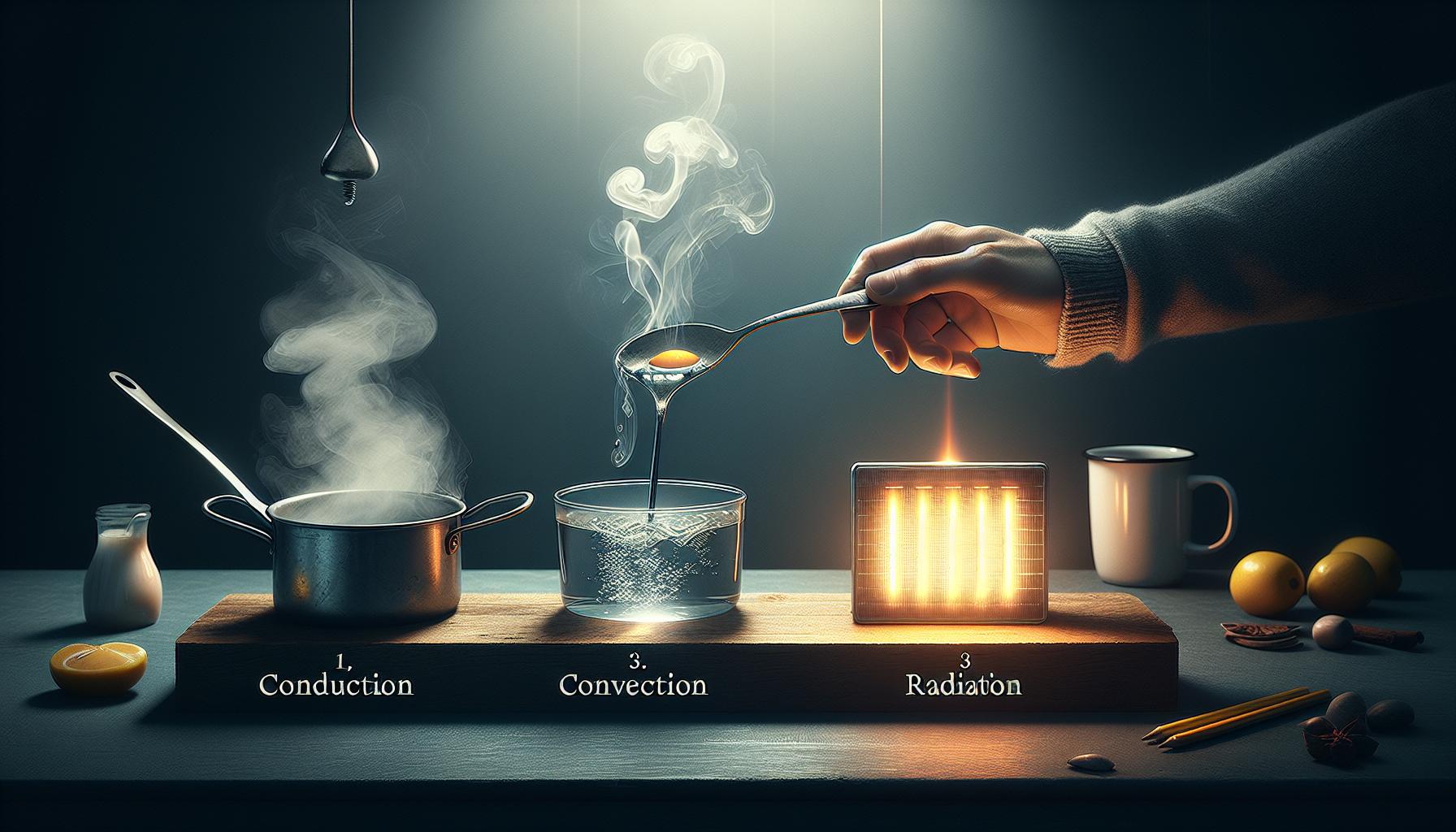
Understanding the mechanisms of heat transfer is crucial for optimizing energy efficiency across various applications. Heat can be transferred via three main methods: conduction, convection, and radiation. Each process plays a distinct role, depending on the materials involved and the environment. By grasping these concepts, professionals can design systems that more effectively manage heat flow, whether they’re insulating buildings or creating efficient heat exchangers.
Conduction
Conduction is the transfer of heat through a solid material without any movement of the material itself. It’s most noticeable in substances like metals, where tightly packed atoms facilitate the rapid transfer of thermal energy. Using Fourier’s Law, heat transfer via conduction can be calculated with the formula:
[
Q = k cdot A cdot frac{(T_1 – T_2)}{d}
]
Here, ( k ) represents the thermal conductivity of the material, which is a measure of how well heat flows through it. For example, copper possesses high thermal conductivity, making it ideal for applications requiring quick heat transfer, such as cooking utensils or electrical components. Conversely, materials like wood or foam insulation have low thermal conductivity, which is advantageous for preventing heat loss in buildings.
Convection
Convection occurs in fluids (both liquids and gases) when warmer portions rise and cooler portions sink, creating a circulating flow. This process can be classified into natural convection, driven by buoyancy forces due to temperature differences, and forced convection, which involves external means like fans or pumps. The heat transfer rate in convection is given by the equation:
[
Q = h cdot A cdot Delta T
]
In this equation, ( h ) stands for the convective heat transfer coefficient, which varies based on factors like fluid velocity and surface characteristics. In designing heating and cooling systems, understanding these principles allows engineers to optimize airflow in HVAC systems or improve the cooling efficiency of electronic devices.
Radiation
Unlike conduction and convection, radiation transfers heat through electromagnetic waves, allowing energy to move even through a vacuum. All objects emit radiation, depending on their temperature and emissivity, defined by the Stefan-Boltzmann Law:
[
Q = varepsilon cdot sigma cdot A cdot (T^4 – T_{sur}^4)
]
In practical terms, this means the efficiency of radiative heat transfer can significantly affect processes like solar heating or thermal insulation. For instance, reflective materials can be used in thermal blankets to keep warmth from radiating away, while materials with higher emissivity, such as black surfaces, can enhance heat absorption.
Understanding these three types of heat transfer is vital for anyone involved in fields ranging from mechanical engineering to environmental science. By applying this knowledge, professionals can devise more efficient systems that minimize energy loss and enhance performance.
Factors That Affect Heat Transfer Rate

Understanding how various factors affect the heat transfer rate can significantly enhance energy efficiency in both industrial applications and household systems. It’s not just about the principles of conduction, convection, and radiation; numerous variables can influence how effectively heat moves through materials or fluids. Key elements such as material properties, fluid dynamics, temperature differentials, and surface conditions play critical roles in determining the rate at which heat is transferred.
Material properties, particularly thermal conductivity, are among the primary factors. Different substances conduct heat at varying rates; for instance, metals like copper and aluminum have high thermal conductivities, enabling quick heat transfer. In contrast, insulative materials like fiberglass or foam slow down heat transfer, which is essential in construction to maintain energy efficiency. The thickness of the material can also affect heat transfer-thicker materials typically exhibit lower transfer rates. Understanding these characteristics allows engineers and designers to select materials strategically to optimize thermal performance.
Fluid dynamics can’t be overlooked either, especially in convection scenarios. The nature of the fluid-whether it’s water, air, or oil-along with its velocity, can dramatically influence heat transfer rates. For instance, increasing the flow rate of a fluid can enhance convective heat transfer due to increased turbulence, which promotes better contact between the fluid and the surface from which it absorbs or discharges heat. Surface characteristics, such as roughness and cleanliness, also impact the convective heat transfer coefficient, further complicating the calculation of heat transfer rates.
Lastly, temperature differences between the heat source and sink critically determine the direction and efficacy of heat transfer. The greater the temperature gradient, the faster the rate of heat transfer, which is essential to remember when designing systems like heat exchangers or refrigeration units. Recognizing and applying these factors not only improves understanding but also equips professionals to craft more efficient thermal management solutions. By integrating this knowledge into practical applications, you can enhance energy saving and system performance effectively.
Step-by-Step Guide to Calculating Heat Transfer Rate
Calculating the heat transfer rate is a critical skill in fields ranging from engineering to environmental science. Whether you’re designing a heating system, calculating energy efficiency in buildings, or optimizing industrial processes, understanding how to compute this rate can lead to significant improvements in performance and cost savings. The heat transfer rate can be assessed through different methods depending on the type of heat transfer involved-conduction, convection, or radiation-each requiring a systematic approach.
To start, you’ll want to identify the appropriate formula based on the heat transfer mechanism at play. For conduction, Fourier’s law states that the heat transfer rate ( Q ) through a material can be calculated using the equation:
[
Q = k cdot A cdot frac{Delta T}{d}
]
where:
– ( k ) is the thermal conductivity of the material (W/m·K),
– ( A ) is the area through which heat is being transferred (m²),
– ( Delta T ) is the temperature difference (°C or K),
– ( d ) is the thickness of the material (m).
For convection, Newton’s law of cooling provides the heat transfer rate:
[
Q = h cdot A cdot Delta T
]
where:
– ( h ) is the convective heat transfer coefficient (W/m²·K).
In the case of radiation, the Stefan-Boltzmann law applies:
[
Q = epsilon cdot sigma cdot A cdot (T^4 – T_s^4)
]
where:
– ( epsilon ) is the emissivity of the surface,
– ( sigma ) is the Stefan-Boltzmann constant ((5.67 times 10^{-8} , W/m^2K^4)),
– ( T ) and ( T_s ) are the absolute temperatures of the surface and surrounding environment in Kelvin.
With the relevant formulas in hand, follow these steps to perform your calculation:
1. Define Your System
Identify what materials and fluids are involved and their respective properties (thermal conductivity, convective coefficients, etc.). Document the dimensions of the objects and the environment conditions such as temperature.
2. Measure Dimensions and Properties
Gather measurement data:
– Area (( A )),
– Thickness (( d )),
– Temperature differences (( Delta T )),
– Material properties (e.g., ( k ) or ( h )).
3. Calculate Heat Transfer Rate
Choose the appropriate formula based on the mode of heat transfer and input your measurements. It’s vital to keep units consistent; for example, all lengths should be in meters.
4. Analyze Results
Evaluate whether the calculated heat transfer rate aligns with expected system performance. High heat loss may suggest poor insulation, while unexpectedly low rates might indicate measuring inaccuracies.
When applied correctly, this calculated rate provides crucial insights into system efficiency and energy use. By mastering these steps, you’ll gain the ability to fine-tune designs and operations across numerous applications, leading to smarter and more economical thermal management solutions.
Thermal Conductivity and Its Significance
Understanding thermal conductivity is fundamental to mastering heat transfer calculations and optimizing various thermal systems. At its core, thermal conductivity (( k )) measures a material’s ability to conduct heat. Higher values indicate that a substance is better at transferring thermal energy, which is crucial in applications like insulation materials, electronics cooling, and heating systems. For instance, metals typically have high thermal conductivity compared to insulators like rubber or glass wool. This variance significantly impacts design choices in engineering, construction, and manufacturing.
When calculating heat transfer through conduction, the formula ( Q = k cdot A cdot frac{Delta T}{d} ) becomes essential. Here, ( k ) directly influences the heat transfer rate (( Q )). In practical scenarios, understanding how different materials behave relative to temperature gradients can guide engineers in selecting appropriate materials for optimal energy efficiency. For example, in constructing energy-efficient buildings, designers might choose materials with lower thermal conductivity to reduce heat loss during winter and minimize heat gain during summer.
Not only does thermal conductivity affect heat transfer calculations, but it also plays a pivotal role in sustaining energy performance in various modern applications. In the electronics industry, for example, thermal conductivity is vital for managing heat in circuit boards-where inadequate heat dissipation can lead to device failure. Similarly, in the field of renewable energy, such as solar panels, materials with the right thermal properties are selected to maximize the efficiency of energy conversion and heat retention.
In summary, grasping the significance of thermal conductivity is more than theoretical knowledge; it translates directly to practical applications that enhance efficiency and performance across diverse fields. Integrating this understanding into heat transfer rate calculations empowers practitioners to innovate and refine systems to meet contemporary energy demands effectively.
Using Heat Transfer Rate in Real-World Applications
Using heat transfer rate effectively in real-world applications is crucial for maximizing efficiency in various industries. From building design to electronics cooling, understanding how to quantify and leverage heat transfer rates can lead to significant improvements in energy consumption and performance.
In the construction industry, architects and engineers must consider heat transfer rates when selecting materials for insulation and exterior walls. For instance, by using advanced insulation materials that exhibit lower thermal conductivity, they can reduce energy loss during heating and cooling seasons. This not only enhances comfort but also cuts down on energy bills, proving invaluable in both residential and commercial settings. Implementing reflective roofing materials can also mitigate heat absorption, improving energy efficiency during hot weather.
The realm of electronics presents another critical application of heat transfer rate analysis. Devices such as CPUs generate heat that can drastically affect performance. Engineers use heat sinks and thermal interface materials with specific thermal conductivities to enhance thermal dissipation, ensuring that devices operate within safe temperature ranges. Proper calculations of heat transfer rates allow for the optimization of cooling systems, contributing to longer lifespans and better reliability of electronic devices.
Moreover, in industrial processes, heat transfer optimization is essential for improving productivity and safety. Processes like chemical reactions and metal processing often generate heat; thus, controlling this heat through effective heat exchange systems minimizes risks of overheating and enhances the efficiency of operations. Monitoring and calculating heat transfer rates in these contexts help in designing systems that can efficiently remove excess heat, maintain optimal operating temperatures, and save on energy costs-not just improving efficiency, but also environmental sustainability.
Through these examples, it’s evident that understanding and applying heat transfer rates is integral to a wide array of sectors. By fostering a more profound understanding of thermal dynamics, professionals can make informed decisions that advance efficiency and sustainability in their respective fields.
Common Mistakes in Heat Transfer Calculations
Calculating heat transfer rates is a crucial aspect of thermodynamics, yet it often entails a series of common missteps that can lead to inaccurate results. Understanding these pitfalls can sharpen your calculations and enhance overall effectiveness in optimizing thermal management. One of the most prevalent errors is neglecting the influence of multiple heat transfer mechanisms, such as conduction, convection, and radiation. Failing to account for the way these forms of heat transfer interact can result in an incomplete picture of the system’s thermal dynamics. Always ensure that you consider all possible heat transfer pathways when performing your calculations.
Another frequent mistake is misidentifying the parameters involved, particularly the material properties like thermal conductivity. For example, utilizing average or outdated values for thermal conductivity instead of the specific conditions relevant to your application can skew your results. This miscalculation can lead to misguided decisions in design or system adjustments. It’s vital to acquire accurate material data-this may involve referring to technical datasheets or conducting measurements under the exact conditions expected in your application.
Additionally, inadequate attention to boundary conditions often complicates accurate heat transfer rate calculations. Whether it’s temperature differences or surface conditions, these factors can substantially impact the outcome of your calculations. For instance, improperly addressing heat loss due to poor insulation or neglecting to set proper ambient conditions can cloud your understanding of the real heat transfer behavior. Always define your boundary conditions clearly before commencing calculations to ensure comprehensive and applicable results.
To avoid these mistakes, a systematic approach is essential. Regularly verify material properties, incorporate all relevant heat transfer methods, and clearly set your boundary conditions. This diligence not only enhances accuracy but also contributes to more efficient designs and processes in practical applications. Remembering to consult up-to-date resources and employing simulation tools can also provide additional insights, simplifying complex calculations and reinforcing good practices in heat transfer analysis.
Tools and Resources for Accurate Heat Transfer Calculations
Understanding heat transfer calculations involves leveraging various tools and resources to ensure accuracy and efficiency. From advanced software applications to fundamental educational materials, a range of options exists to aid in this critical aspect of thermodynamics.
One of the most effective tools for heat transfer calculations is simulation software. Programs like ANSYS Fluent and COMSOL Multiphysics allow users to model complex thermal systems and visualize heat transfer processes in real-time. These applications can simulate conduction, convection, and radiation under varying conditions, enabling engineers to optimize their designs before any physical implementation. Additionally, many of these tools come with built-in libraries of material properties, which can significantly reduce the time spent on data collection.
For those seeking a more hands-on approach, spreadsheets can be invaluable. Using Excel or Google Sheets, professionals can create custom templates that include the essential formulas for heat transfer rates. Not only does this method enhance transparency in calculations, but it also allows for quick adjustments and real-time data analysis. Including graphs and charts can further aid in visualizing trends and comparing different scenarios.
Furthermore, academic textbooks and online courses provide foundational knowledge that can inform practical calculations. Recommended texts such as “Introduction to Heat Transfer” by Frank P. Incropera offer comprehensive insights into the theories underlying heat transfer, while platforms like Coursera and edX host courses that cover both theoretical principles and practical applications. Engaging with these resources helps bridge the gap between complex theoretical concepts and their real-world applications, making heat transfer manageable for researchers and professionals alike.
In conclusion, a combination of simulation software, spreadsheet tools, and educational resources forms a robust toolkit for accurate heat transfer calculations. By leveraging these tools, professionals can avoid common pitfalls, streamline their processes, and enhance the efficiency of their designs in various applications.
Advanced Concepts in Heat Transfer Analysis
Heat transfer is a multifaceted domain ripe with advanced principles that can profoundly elevate your calculations and applications. Understanding these advanced concepts enhances the precision and applicability of the heat transfer rates in various settings, whether in industrial processes, HVAC systems, or in the development of energy-efficient buildings. One critical area is the analysis of transient heat transfer, where the temperature of a system varies with time. This requires a keen understanding of unsteady-state conditions as opposed to the more straightforward steady-state analysis.
In transient analysis, the heat conduction equation, also known as Fourier’s law, becomes crucial. The equation not only handles the spatial distribution of temperature but also accounts for changes over time. The importance of boundary conditions-like fixed temperature, insulated, or convective conditions-cannot be overstated. These conditions dictate how heat flows into or out of the system, impacting the overall efficiency and effectiveness of thermal management strategies. Understanding how to employ techniques such as the Laplace transform can simplify these calculations significantly, making them more accessible and practical for engineers and scientists.
Understanding Heat Exchangers
Heat exchangers play a pivotal role in thermal systems, and the principles governing their design and operation exemplify advanced heat transfer concepts. A practical approach to understanding heat exchangers lies in the application of the Log Mean Temperature Difference (LMTD) method versus the Effectiveness-NTU method. The LMTD approach is suitable for systems with a known inflow temperature and requires solving for the mean temperature difference across the exchanger. On the other hand, the effectiveness-NTU approach is ideal for complex systems where the heat capacity rates may vary, providing a more generalized solution for performance assessment.
To illustrate, consider a counterflow heat exchanger where two fluids move in opposite directions. This arrangement maximizes the temperature gradient between the fluids, thereby optimizing the heat transfer rate. It’s essential to calculate the overall heat transfer coefficient (U), which combines the effects of convection within the fluids and conduction through the exchanger’s wall. Accurate determination of U can greatly influence system design and operational efficiency.
Emerging Technologies: Nanofluids and Phase Change Materials
Emerging technologies such as nanofluids and phase change materials (PCMs) push the boundaries of conventional heat transfer methods. Nanofluids, which are fluids enhanced with nanoparticles, demonstrate improved thermal conductivity, thus enabling more efficient heat transfer in systems such as cooling and heating applications. On the other hand, PCMs store and release thermal energy during phase transitions, significantly improving energy management in applications like building temperature regulation.
Incorporating these innovative materials requires a solid grasp of their thermal properties, which can vary significantly from their base fluids. Engineers now compute effective thermal conductivity using metrics from both the base fluid and the nanoparticles, often employing empirical or semi-empirical correlations to predict the performance accurately.
In conclusion, delving into these advanced concepts reinforces the foundational knowledge of heat transfer rates and their applications, from transient heat conduction to the integration of cutting-edge materials and technologies, ultimately leading to greater effectiveness and efficiency in thermal management practices.
Case Studies: Heat Transfer Rate in Different Industries
In examining how heat transfer rates manifest across various industries, it’s crucial to recognize that these rates often dictate operational efficiency and energy use. For instance, in the automotive sector, manufacturers focus on maximizing heat transfer in engine cooling systems. The optimal heat exchanger design ensures that engines operate within safe temperature ranges, improving performance while reducing emissions. Engineers utilize both theoretical calculations and empirical testing to confirm that the heat transfer rate meets required specifications, driving innovations in design and materials.
In the pharmaceutical industry, maintaining the correct temperature during the production and storage of medications is critical. Here, the principles of heat transfer directly influence product quality and safety. Custom temperature-controlled environments, such as incubators and refrigerators, employ advanced heat transfer calculations to ensure that temperature fluctuations do not compromise drug efficacy. Through rigorous analysis, including the heat transfer coefficient and conduction through insulation materials, industry professionals can design systems that maintain consistent temperatures, enhancing product reliability.
The food processing industry also greatly benefits from understanding heat transfer. For example, pasteurization involves heating food products to eliminate pathogens. Manufacturers carefully calculate heat transfer rates to ensure the process effectively sterilizes products without affecting taste or nutritional value. This involves evaluating heat transfer modes-conduction, convection, and radiation-in designing heat exchangers. By precisely controlling the rate, companies can achieve safer products while conserving energy.
Through these case studies, it’s clear that mastering the intricacies of heat transfer rates not only supports operational efficiency but also drives innovations in processes and technologies across industries. By integrating comprehensive calculations and real-world applications, professionals can significantly enhance their systems’ effectiveness, leading to improved energy management and product quality.
Frequently Asked Questions
Q: What is the unit of measurement for heat transfer rate?
A: The heat transfer rate is commonly measured in watts (W), which represents joules per second. This unit indicates how much energy is transferred as heat each second. Understanding this measurement is crucial when applying the essential formula for heat transfer rate in various calculations.
Q: How does the heat transfer rate impact energy efficiency in systems?
A: The heat transfer rate significantly influences energy efficiency as it determines how effectively heat moves through materials or systems. A lower transfer rate often indicates better insulation, leading to lower energy costs on heating or cooling. Checking the factors that affect heat transfer rate helps optimize efficiency.
Q: Why is thermal conductivity significant in calculating heat transfer?
A: Thermal conductivity measures a material’s ability to conduct heat. It is vital in calculations of heat transfer rate, as it directly affects how quickly heat moves through different materials. Understanding this property helps in precise calculations during the step-by-step guide to calculating heat transfer rate.
Q: What are common applications of heat transfer rate calculations?
A: Heat transfer rate calculations are widely used in engineering, HVAC (heating, ventilation, and air conditioning), and materials science. They help design efficient thermal systems, ensure comfort in buildings, and optimize processes in various industries. Refer to the section on using heat transfer rate in real-world applications for more examples.
Q: How can one avoid common mistakes in heat transfer calculations?
A: To avoid common mistakes in heat transfer calculations, ensure you correctly identify and apply the appropriate heat transfer method (conduction, convection, or radiation) for your scenario. Double-check your units and values, and refer to the section on common mistakes in heat transfer calculations for detailed tips.
Q: When is it necessary to perform heat transfer rate calculations?
A: Performing heat transfer rate calculations is necessary when designing thermal systems, assessing insulation efficiency, or troubleshooting energy loss in buildings or equipment. Use the step-by-step guide in the article to systematically approach these calculations.
Q: What role does temperature difference play in heat transfer rate?
A: The temperature difference between two surfaces is a critical factor in heat transfer rate; greater differences typically result in higher rates of heat flow. This principle is integral to understanding the essential formula for heat transfer rate.
Q: How does one determine the right tools for heat transfer calculations?
A: To determine the right tools for heat transfer calculations, consider the complexity of the problem and your needs. Simple cases may only require basic formulas, while advanced calculations could benefit from simulation software or specialized calculators. The section on tools and resources for accurate heat transfer calculations provides further guidance.
Concluding Remarks
Now that you’ve mastered the steps to find the heat transfer rate, it’s time to put this knowledge into practice! Remember, accurately calculating heat transfer is essential for optimizing energy efficiency in your projects. If you’re looking to deepen your understanding, check out our guides on “Advanced Heat Transfer Concepts” and “Thermal Conductivity and Its Applications”.
Don’t hesitate to reach out if you have questions or share your insights in the comments below! You can also subscribe to our newsletter for the latest updates and tips in thermal management technologies. Your journey in mastering heat transfer is just beginning-explore our resources and elevate your expertise today!
Get our latest guides, news, and insights highlighted in your Google Search & AI Overviews.